Creatures notes
28 notes on magical beasts and how to handle them, written for wizarding-school roleplay. Each one has a teaching tip for professors.
Search, filter and quiz these notes
A magical rowan tree. Its bark is used in healing potions, and Bowtruckles guard it.
- Anyone touching the trunk is said to be safe from Dark creatures.
- Offer the Bowtruckles woodlice before you take any bark.
- Take only a little, so the tree is not harmed.
Teaching tip: Pair it with the Bowtruckle. A student must get a strip of bark without upsetting the tree's guardians.
Also on: Herbology
A soothing yellow liquid for cuts and sore skin.
- It is made from the strained and pickled tentacles of a Murtlap, a rat-like sea creature.
- You soak the injury in a bowl of it.
- It eases pain, and helps a wound to heal.
Teaching tip: Use it after a practice duel. A student soaks a scraped hand, and describes the relief.
Also on: Potions
The glowing red eggs of the Ashwinder, a thin grey serpent born from a magical fire left burning too long.
- The eggs give off great heat, and can set a house alight.
- They must be frozen before they can be used.
- They are an ingredient in love potions.
Teaching tip: Tell the story of an unwatched fire, then ask students how they would search a room for the eggs.
Also on: Potions
A class where students learn to look after magical animals safely and respectfully.
- Always follow the teacher's instructions.
- Never approach a creature without being told it is safe.
- Each creature has its own rules for meeting and handling.
Teaching tip: Open with the safety rules before the beast appears. Students recite them as a group, then meet the creature.
The Ministry ranks magical creatures from harmless to deadly using a five-X scale.
- X is boring and harmless.
- XX is harmless and can be domesticated.
- XXX needs a competent wizard.
- XXXX is dangerous and needs special skill.
- XXXXX is known to be deadly and cannot be tamed.
Teaching tip: Give each student a creature and have them argue for a rating, then compare with the official one.
A fiery bird that bursts into flame when it is old and is reborn from its own ashes.
- Its tears can heal wounds.
- Its song gives courage to good people and fear to bad ones.
- It can travel by vanishing in flames and appearing elsewhere.
Teaching tip: Have students describe the moment of rebirth in their own words, then link it to resilience.
A graceful horse-like creature with a single horn, and a creature of purity and rarity.
- Foals are gold, then silver, then become pure white as adults.
- Their blood is silver and is said to keep a person alive, but with a terrible cost.
- Hurting one is an unforgivable act.
Teaching tip: Discuss respect. Ask students how a careful student behaves around a creature that is quick to flee.
A giant spider that can grow bigger than a person and, in some stories, can talk.
- It lives in colonies deep in forests.
- It is on the highest danger rating.
- Never approach alone.
Teaching tip: Treat it as a safety lesson, not a horror scene. Ask what a sensible student does when they find a web.
A fast, armoured creature that sparks, stings and sometimes explodes.
- A strange cross-breed.
- Hard to keep and impossible to train.
Teaching tip: Comic relief lesson: students describe a Skrewt escape in one sentence each, escalating the chaos.
A dull brown worm that eats lettuce and does almost nothing else.
- Its mucus thickens some potions.
- Almost impossible to hurt or be hurt by.
Teaching tip: Ask students why a boring creature is still useful. Link it to potions.
A tiny blue winged creature that loves mischief and sometimes lifts people off the ground.
- They are fast, noisy and difficult to catch.
- A spell for stopping them is usually enough.
Teaching tip: Set a chaos scene: pixies are loose in the classroom. Students describe one thing they do to restore order.
A small, green water creature with long fingers that grabs at passing swimmers.
- Lives in lakes and ponds.
- Its fingers are brittle, so a firm response can free you.
Teaching tip: Ask students how a calm response differs from panic when something grabs your ankle in water.
A huge, fire-breathing reptile that is incredibly powerful and dangerous.
- Many types, such as the Hungarian Horntail.
- Keeping one as a pet is illegal.
- Handled only by trained dragonkeepers.
Teaching tip: Quick debate: should dragons be kept on a reserve or left in the wild? Students argue from safety and ethics.
A gentle, ape-like creature that can turn invisible.
- Its silvery fur is used to weave invisibility cloaks.
- It can sense what might happen next.
Teaching tip: Ask students what they would do if they were invisible for an hour. Discuss responsibility.
A bird-like creature with a snake's body that grows or shrinks to fit the space it is in.
- It is fiercely protective of its eggs.
- Its silvery eggs are valuable.
Teaching tip: Fun size-change exercise: students describe a scene where the creature grows to fit a small room and then shrinks to leave.
A tiny, round, fluffy pet that comes in many bright colours.
- A smaller, tamer cousin of the Puffskein.
- Popular with younger students.
Teaching tip: Pet-care roleplay: students describe how their character cares for a tiny puffball and what it eats.
A very shy creature that leaves its burrow only at the full moon.
- Pale grey smooth body, big round eyes on top of its head, thin legs, huge flat feet.
- Dances on its hind legs in the moonlight, leaving patterns in wheat fields.
- Its dung, gathered before sunrise, makes magical plants grow fast and strong.
“Mooncalves only dance under a full moon, which is why Muggles find crop circles.”
Teaching tip: Ask why a shy creature only appears in moonlight, then link it to the crop-circle legend as an example of a magical cause for a plain sight.
A person who turns into a wolf at every full moon after being bitten by another werewolf.
- Wolfsbane Potion lets them keep their own mind during the change.
- Dangerous only on the full moon.
Teaching tip: Handle it as a medical and safety topic, not a monster hunt. Ask how a school keeps a classmate safe and respected at the full moon.
A clever cat-like creature with spotted fur, large ears and a tail like a lion's.
- Very good at spotting untrustworthy people.
- Can breed with ordinary cats, so some pet cats are part Kneazle.
Teaching tip: Use it for a character exercise: how would your character act around a creature that can sense bad intentions?
Front half giant eagle, back half horse. Extremely proud.
- Bow first, keep eye contact, and wait for it to bow back.
- Never insult one.
Teaching tip: Practice the bow etiquette as a short scene. Students narrate each step: bow, eye contact, wait, approach.
Skeletal winged horses that can only be seen by people who have seen death.
- They pull the school carriages.
- Gentle despite their looks.
Teaching tip: Ask why a creature can look frightening and still be gentle. Then link it to judging people or creatures by first looks.
Proud, intelligent beings with a human upper body and a horse's body. A herd lives in the Forbidden Forest.
- Skilled in star-reading, healing and archery.
- They dislike being treated as servants or pets.
Teaching tip: Practice respectful meeting scenes. Students describe one thing they would never say to a centaur, and why.
A shape-shifter that turns into whatever the person in front of it fears most.
- Lives in dark, closed spaces like wardrobes.
- Beaten with the charm Riddikulus and, above all, laughter.
Teaching tip: Safe practice scene: each student names something mildly silly to fear, then invents a funny form to turn it into. Keep real fears out of it.
Cloaked beings that drain happiness and guard the wizard prison Azkaban.
- Driven off with the Patronus Charm.
- Chocolate helps afterwards.
Teaching tip: Keep it light and supportive. Students list ways their characters would help a friend recover afterward, such as warmth, food and company.
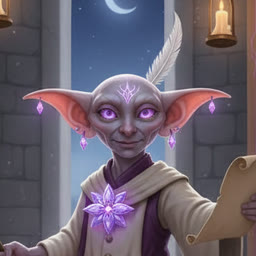
Small magical servants bound to a family or place. Many work in the Hogwarts kitchens.
- Freed only when their master gives them clothing.
Teaching tip: Discuss fair treatment in the school community. Ask how a thoughtful student shows respect to the people who keep the castle running.
Wizards send letters and parcels by owl. Post arrives at breakfast in the Great Hall.
- School owls live in the Owlery.
- A Howler is a red letter that shouts its message.
Teaching tip: Have students write a short owl letter in character, then trade and reply. It is a gentle way to practice voice and manners.
A small twig-like guardian of trees whose wood is good for wands.
- Hard to spot. Offer woodlice to calm one.
Teaching tip: Ask how a careful student would take a branch for a wand without harming the guardian. It is a small lesson in gathering with care.
A fluffy black burrowing creature with a long snout that cannot resist shiny things.
- Great at finding treasure, terrible indoors.
Teaching tip: Set a quick scene: a Niffler loose in class. Students narrate one sensible action each, and one silly one.